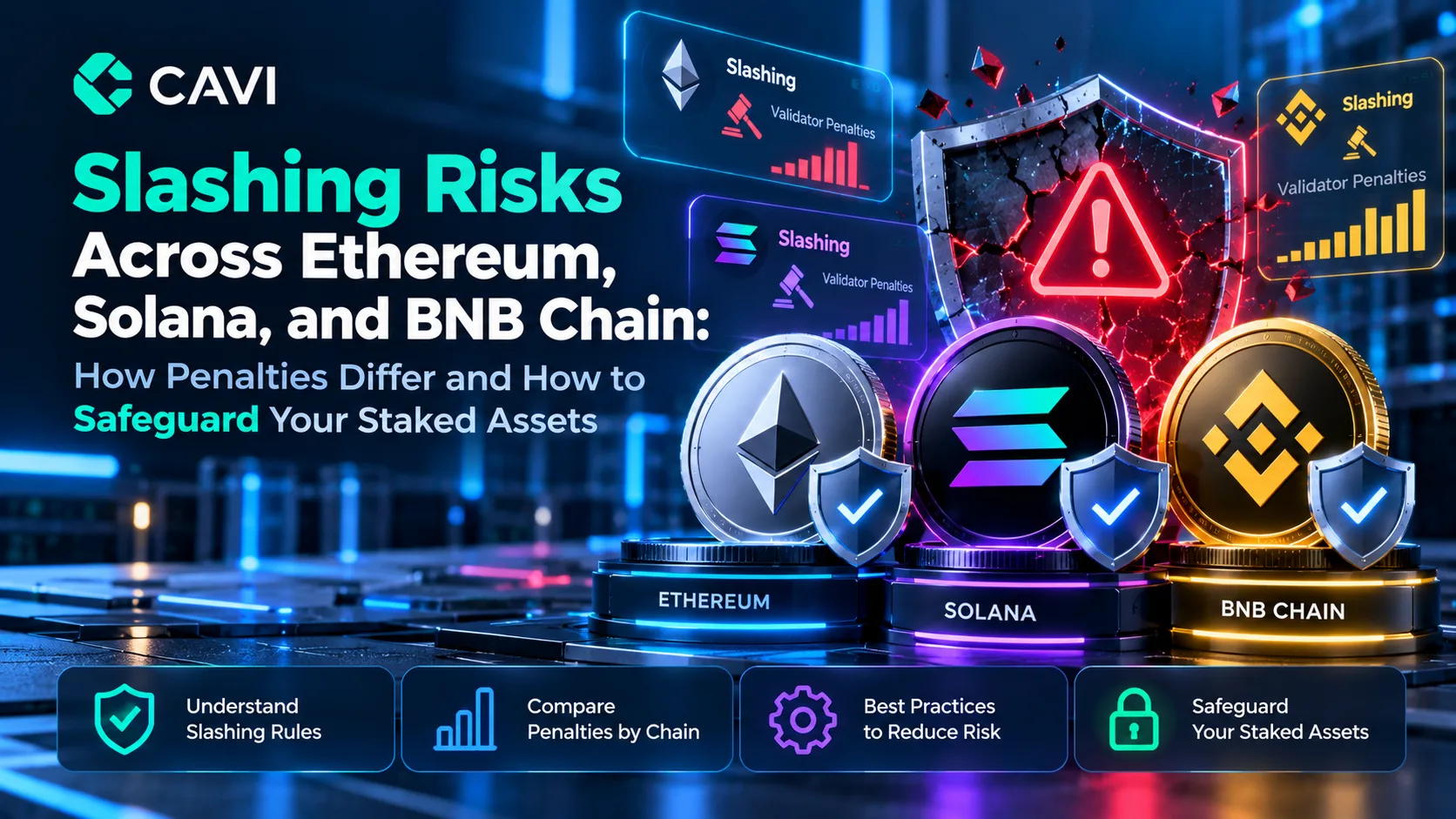
Slashing Risks Across Ethereum, Solana, and BNB Chain: How Penalties Differ and How to Safeguard Your Staked Assets
By CAVI Team · 2026-09-18
Introduction
Staking your crypto can turn idle assets into a steady stream of daily rewards, but it also introduces a unique risk: slashing. When a validator breaks consensus rules, the protocol can destroy part of the staked balance – a harsh penalty that protects network security. For investors who spread their ETH, SOL, or BNB across multiple chains, understanding how each network penalises misbehaviour and what you can do to avoid it is essential.
In this article we dissect the slashing mechanics of Ethereum, Solana, and BNB Chain, compare their trigger events and penalty formulas, and give you a checklist of best‑practice safeguards. Whether you run your own node or delegate through CAVI’s validator‑as‑a‑service (VaaS), these steps will help you keep more of your stake working for you.
1. Slashing 101 – Why It Exists
Slashing is the protocol‑level enforcement tool that punishes validators for:
- Double‑signing – proposing two different blocks for the same slot/height.
- Surround voting – attesting to an earlier epoch while also attesting to a later one, violating the Casper FFG rules.
- Inactivity – repeatedly missing duties, which can jeopardise finality.
- Other protocol‑specific offences (e.g., equivocation on BNB Chain’s PoSA).
The penalty typically burns a portion of the validator’s effective balance and may also force an early exit from the active set. Delegators share the loss because they are bonded to the same validator.
Bottom line: Slashing protects the chain, but it can erode the very capital you’re trying to grow.
2. Ethereum Slashing Mechanics
2.1 Trigger Events
Ethereum’s Proof‑of‑Stake (PoS) consensus is unforgiving. The most common slashable offences are:
- Double‑signing a block or an attestation.
- Surround voting (violating the Casper FFG rule).
- Inactivity leaks after prolonged downtime (the “inactivity penalty” is separate but can lead to slashing if the validator stays offline for > 2 epochs).
2.2 Penalty Calculation
According to ConsenSys, the penalty has two components:
- Immediate penalty – roughly 1 ETH (exactly 1/32 of the validator’s effective balance) is burned as soon as the offence is proven【https://consensys.io/blog/understanding-slashing-in-ethereum-staking-its-importance-and-consequences】.
- Exit queue penalty – the slashed validator is placed in a slashed_exiting state for about 36 days. During this period the validator:
- Stops earning rewards.
- Pays a missed‑epoch fine of about 8,000 GWei (0.000008 ETH) per epoch missed.
If multiple validators are slashed simultaneously, the penalty scales proportionally, as noted by Rhodium Verse【https://rhodiumverse.com/ethereum-validator-slashing-conditions-and-prevention-2】.
2.3 How to Avoid Slashing on Ethereum
| Practice | Why It Helps | Tools & Resources |
|---|---|---|
| Run a single validator per keypair | Prevents accidental double‑signing caused by duplicate instances. | CAVI VaaS isolates each keypair; open‑source clients like Prysm or Lighthouse have built‑in safety checks. |
| Maintain 99.9 %+ uptime | Missed epochs trigger inactivity penalties that can snowball into slashing. | Use monitoring services (Prometheus + Grafana) and automated alerts. |
| Stay on the latest client version | Bugs in older releases have historically caused inadvertent double‑signing. | Follow the Ethereum Foundation release notes (ethereum.org). |
| Enable validator empowerment (e.g., proposer‑boost) | Reduces the chance of missing a block proposal slot. | Docs: https://ethereum.org/en/staking/validator/ |
CAVI’s managed validator service automatically enforces these safeguards: dedicated hardware, multi‑region failover, and real‑time health checks. Delegators can still reap daily rewards while the platform handles the heavy‑lifting.
3. Solana Slashing – Designed but Dormant
3.1 Is There Slashing?
Solana was built with a slashing module, but as of 2024 the mechanism is inactive for most validator misbehaviour. DasFinanzen explains that the protocol “does not currently have an active slashing component for most validator offences”【https://dasfinanzen.de/does-solana-have-slashing】.
That said, the codebase still contains logic for:
- Double‑signing – if a validator signs two competing blocks.
- Undue downtime – prolonged unavailability could be penalised in future upgrades.
3.2 Practical Risk Assessment
Because slashing is effectively dormant, the financial risk is lower than on Ethereum. However, validators can still be removed (jail‑ed) for persistent downtime, which leads to loss of delegated rewards and reputational damage.
3.3 Safeguarding SOL Stakes
| Safeguard | How It Works |
|---|---|
| Delegate to reputable validators | Look for validators with > 95 % uptime and a transparent fee structure. CAVI’s Solana node roster is vetted against Figment’s performance criteria (figment.io). |
| Monitor leader schedule | Solana’s leader rotation is rapid (≈400 ms slots). Use tools like solana‑monitor to ensure your chosen validator is producing blocks. |
| Stay informed on protocol upgrades | Future network upgrades may activate slashing. Follow the Solana blog (solana.com) and community channels. |
Even though slashing is rare, a disciplined delegation strategy keeps your SOL safe and your rewards flowing.
4. BNB Chain Slashing Overview
BNB Chain (formerly BNB Smart Chain) operates a Proof‑of‑Staked‑Authority (PoSA) model. Slashing is active and targets two primary offences:
- Double‑signing – forging two blocks for the same height.
- Extended downtime – failing to produce blocks for a defined number of epochs.
The official BNB Chain validator documentation states that a slashing event can burn up to 5 % of the validator’s staked BNB and automatically eject the validator from the active set【https://docs.bnbchain.org/validator/slashing】.
4.1 Penalty Mechanics
- Immediate burn – a flat 5 % of the effective stake is destroyed.
- Exit penalty – the validator is forced out, losing future rewards and incurring a small “unbonding” fee (≈0.1 % of the remaining stake).
Because the penalty is proportionally larger than Ethereum’s 1 ETH fixed burn, smaller validators feel a heavier relative impact.
4.2 How to Minimise BNB Chain Slashing
| Action | Reason |
|---|---|
| Run a single validator per consensus key | Prevents accidental equivocation. |
| Implement automated health checks | Detects network latency or hardware failures before they cause missed blocks. |
| Participate in BNB Chain’s validator incentive program | Earns extra rewards for high uptime, offsetting any small penalties. |
| Use CAVI’s BNB Chain VaaS | Provides geographically distributed nodes and automatic key‑rotation, dramatically lowering the chance of double‑signing. |
5. Side‑by‑Side Comparison
| Feature | Ethereum | Solana | BNB Chain |
|---|---|---|---|
| Slashing status | Active, aggressive | Designed but inactive (as of 2024) | Active, moderate |
| Typical trigger | Double‑sign, surround voting, inactivity | Double‑sign (theoretically) | Double‑sign, prolonged downtime |
| Immediate penalty | ~1 ETH (≈1/32 balance) | None (no active burn) | Up to 5 % of stake |
| Exit queue | ~36 days, epoch‑based fines | Not applicable (no active slashing) | Immediate ejection, small unbonding fee |
| Typical % of stake lost | 1 ETH ≈ 3 % of a 32 ETH validator (varies with price) | Near‑zero (no burn) | Up to 5 % |
| Key mitigation | Single key per validator, 99.9 % uptime, client updates | Choose high‑uptime validators, monitor leader schedule | Single key, health checks, use reputable VaaS |
6. Practical Checklist – Protecting Your Multi‑Chain Stake
- Diversify delegations – Spread your ETH, SOL, and BNB across at least two reputable validators per chain.
- Leverage CAVI’s validator‑as‑a‑service – CAVI runs Figment‑grade infrastructure, automatic key rotation, and daily reward payouts. See our guide on How CAVI Works for details.
- Set up real‑time monitoring – Use Prometheus/Grafana for Ethereum, solana‑monitor for SOL, and BNB Chain’s metrics endpoint for BNB.
- Keep software current – Subscribe to client release notes (e.g., Prysm, Lighthouse, solana‑validator, BNB Chain validator client).
- Regularly review validator performance – Check the on‑chain slashing history and community reputation. Reddit’s r/ethstaker and r/solana often flag misbehaving validators.
- Automate rebalancing – CAVI’s daily rebalancing feature can shift rewards to the highest‑yielding chain while preserving your original stake distribution. Learn more in our How to Automate Daily Rebalancing article.
- Stay informed on network upgrades – Upgrades can enable or modify slashing rules. Our post on How Network Upgrades Impact Staking Rewards explains recent changes for Ethereum Shanghai, Solana 2024, and BNB Chain Beacon Chain.
7. What the Community Says
- On r/ethstaker, users frequently discuss “double‑signing incidents” and share monitoring scripts to catch validator restarts before they cause a slash. See the discussion thread for practical tips: https://reddit.com/r/ethstaker.
- On r/solana, the conversation centres on the inactive slashing and the importance of selecting validators with high leader‑slot performance: https://reddit.com/r/solana.
- On X (formerly Twitter), the hashtag #staking surfaces many posts about recent BNB Chain slashing events and how delegators responded: https://x.com/search?q=%23staking.
These real‑world insights reinforce the technical safeguards outlined above.
8. Conclusion
Slashing is a necessary defense for PoS networks, but its impact varies dramatically across Ethereum, Solana, and BNB Chain. Ethereum’s fixed‑penalty model can wipe out a sizable chunk of a validator’s balance, Solana’s current inactivity keeps slashing risk low, while BNB Chain’s proportional 5 % burn can be painful for smaller operators.
By choosing reputable validators, maintaining rigorous uptime, and leveraging CAVI’s managed staking infrastructure, you can dramatically reduce the likelihood of a costly slash while still earning competitive daily rewards. Stay vigilant, keep your software up‑to‑date, and let CAVI handle the heavy lifting—so you can focus on growing your portfolio.
Further Reading (Internal Links)
- Liquid Staking Explained: Earn Daily Rewards Without Locking Up Your Crypto on Ethereum, Solana and BNB Chain
- How to Automate Daily Rebalancing of Staked Assets Across Ethereum, Solana and BNB Chain
- How Network Upgrades Impact Staking Rewards: Ethereum Shanghai, Solana 2024 Upgrade, and BNB Chain Beacon Chain Explained
- Is Validator Staking Safe? Risks, Protections & On‑Chain Verification
- Understanding Crypto Staking Risks (And How to Manage Them)
External References:
- Ethereum slashing overview – ConsenSys blog (https://consensys.io/blog/understanding-slashing-in-ethereum-staking-its-importance-and-consequences)
- Solana slashing status – DasFinanzen article (https://dasfinanzen.de/does-solana-have-slashing)
- BNB Chain slashing documentation (https://docs.bnbchain.org/validator/slashing)
- Figment validator standards (https://figment.io)
- Ethereum official staking guide (https://ethereum.org/en/staking/validator/)