How to Automate Daily Rebalancing of Staked Assets Across Ethereum, Solana, and BNB Chain
By CAVI Team · 2026-09-04
Introduction
Staking on multiple chains can boost your overall yield, but it also creates allocation drift – the moment‑to‑moment shift in how much capital sits on each network. When Ethereum’s APR slides to ~3 % while Solana is offering 7‑8 % (AstraSol, 2025), a static allocation can leave money on the table.
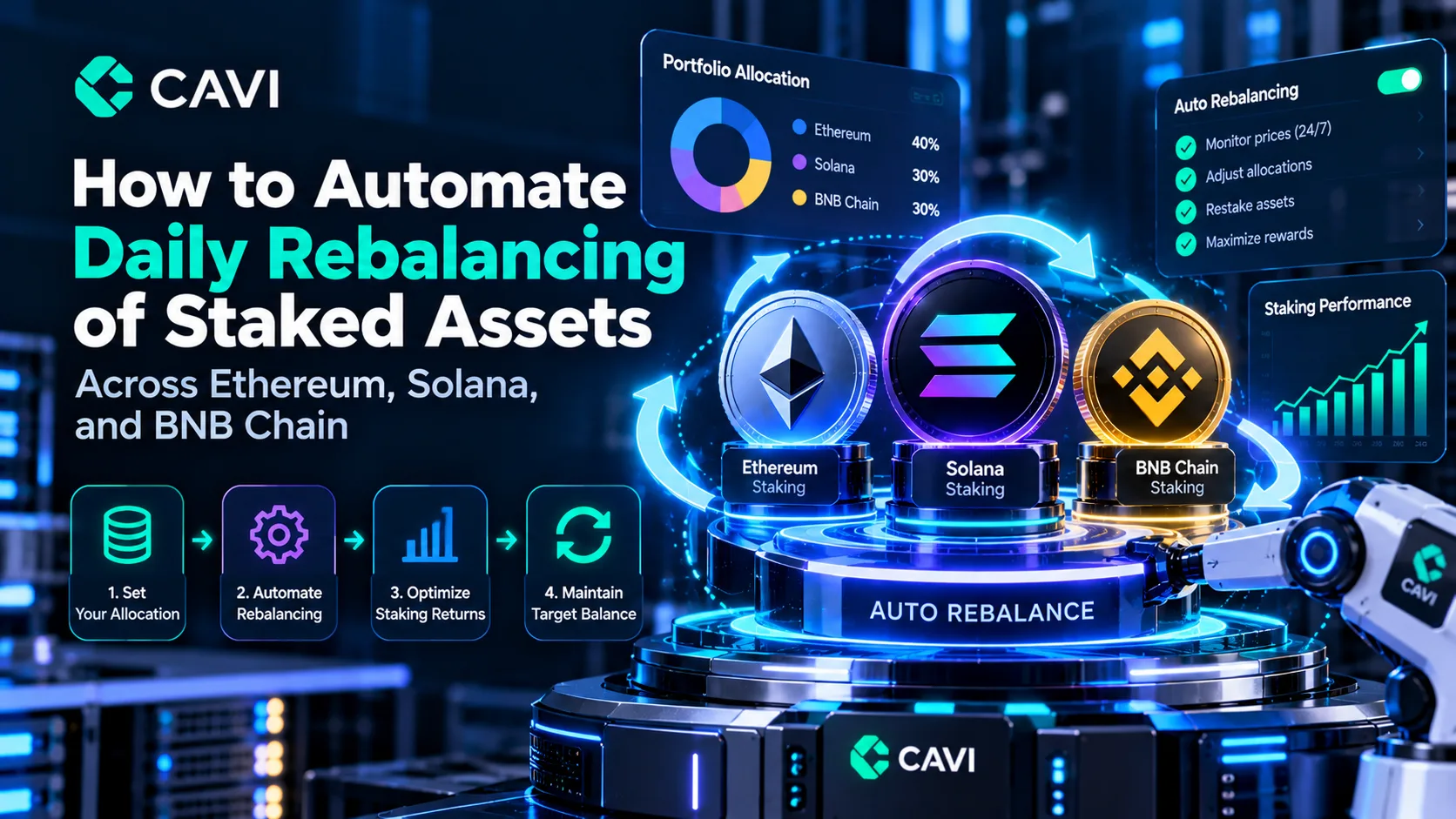
This guide walks you through a complete, automated workflow that:
- Monitors daily reward rates on Ethereum, Solana, and BNB Chain.
- Triggers a rebalance when a pre‑set drift threshold is breached.
- Executes the necessary bridge‑and‑stake transactions without manual intervention.
- Leverages CAVI’s multi‑chain dashboard for visibility and risk controls.
By the end, you’ll have a repeatable script (or low‑code bot) that keeps your validator stakes aligned with your target risk‑return profile while minimizing slashing exposure.
Why Automate Rebalancing?
- Yield differentials change fast – Network upgrades, fee redistribution, and validator commission shifts can swing APYs by a full percentage point in a single day (MintLocke, 2024).
- Human reaction is slow – Manual moves often miss the narrow window before a bridge fee erodes the arbitrage profit.
- Risk management – Over‑exposure on a single chain raises slashing risk; automated caps keep you within safe limits.
“I used a simple Python loop to keep my ETH/sol stake at 40/60. The bot saved me ~2 % APR over six months compared to manual checks.” – discussion on r/ethstaker.
Core Concepts
| Concept | What It Means | Typical Parameter |
|---|---|---|
| Target Allocation | Desired % of total staked capital per chain (e.g., 45 % ETH, 35 % SOL, 20 % BNB). | User‑defined based on risk appetite |
| Drift Threshold | Percent deviation from target that triggers a rebalance. | 5 % – 10 % is common (MintLocke). |
| Rebalance Frequency | How often the automation checks the portfolio. | Every 24 h for daily yield optimization |
| Slashing Buffer | Reserve capital kept un‑staked to cover potential penalties. | 1 % – 2 % of total stake |
Step 1: Set Up Your CAVI Dashboard
- Create a CAVI account and link your validator nodes on Ethereum, Solana, and BNB Chain.
- In the Multi‑Chain Dashboard, enable Daily Rewards View – this aggregates rewards from Figment‑grade infrastructure (Figment.io) and shows real‑time APY estimates.
- Define a Target Allocation using the dashboard’s sliders. For example:
- Ethereum – 45 %
- Solana – 35 %
- BNB Chain – 20 %
- Set a Drift Alert at 6 % (CAVI will send a webhook when any chain moves beyond this range).
Internal reference: Learn more about CAVI’s architecture in our article How CAVI Works – Validator Nodes, Figment Infrastructure & Your Daily Rewards.
Step 2: Choose Your Automation Engine
You have two practical options:
| Option | Pros | Cons |
|---|---|---|
| CapVault + Zap Scripts | Non‑custodial, audited contracts, built‑in multi‑chain bridges. | Requires familiarity with CapVault’s API. |
| Custom Python/Node.js Bot | Full control, can integrate CAVI webhooks directly. | More development effort. |
For most users, the CapVault + simple Zapier webhook combo provides a low‑code path while retaining security.
2.1. Using CapVault
- Sign up at CapVault.io and connect the same wallets you use on CAVI (hardware wallet or Ledger‑compatible).
- Enable Auto‑Stake for ETH, SOL, and BNB. CapVault will automatically wrap assets into liquid‑staking tokens (e.g., stETH, stSOL, stBNB) that can be moved across chains without exiting the staking contract.
- Create a Zap that listens to CAVI’s webhook (drift alert) and triggers a CapVault rebalance action.
2.2. Building a Custom Bot (Python Example)
import requests, json, time

CAVI_WEBHOOK = "https://cavi.io/api/webhook"
CAPVAULT_API = "https://api.capvault.io/v1/rebalance"
TARGET = {"eth":0.45, "sol":0.35, "bnb":0.20}
THRESHOLD = 0.06

while True:
    # 1. Pull current balances from CAVI
    resp = requests.get(f"{CAVI_WEBHOOK}/balances")
    balances = resp.json()
    total = sum(balances.values())
    # 2. Compute drift
    drift = {k: abs(v/total - TARGET[k]) for k,v in balances.items()}
    if any(d > THRESHOLD for d in drift.values()):
        # 3. Call CapVault rebalance endpoint
        payload = {"target": TARGET}
        requests.post(CAPVAULT_API, json=payload)
        print("Rebalance executed", payload)
    time.sleep(86400)  # run once per day
External reference: The automation loop pattern mirrors the workflow described by MintLocke in How to Rebalance Your Crypto Portfolio (And Why to Automate).
Step 3: Bridge Assets Efficiently
Cross‑chain moves are the costliest part of rebalancing.
- Ethereum ↔ BNB – Use Binance Bridge (≈$12 per $10 K transfer) or Synapse for lower fees on larger amounts.
- Solana ↔ Ethereum – Wormhole offers fast finality (≈$8‑$10) but watch for temporary fee spikes during network congestion.
Tip: Keep a small liquidity buffer (≈2 % of total stake) in a stablecoin on each chain to pay bridge fees without unstaking.
Step 4: Monitor Slashing Risk
Validator slashing is rare on well‑maintained nodes, but exposure multiplies when you concentrate too much on one chain.
- Ethereum – Slashing occurs at >33 % of stake being offline; most reputable validators have <0.5 % downtime (Ethereum.org).
- Solana – Slashing is triggered by double‑signing; the network’s low‑latency design reduces this risk, but a single node outage can affect up to 2 % of total stake (Solana.com).
- BNB Chain – Slashing thresholds are similar to Ethereum, with an additional “inactivity penalty” that scales with network participation.
Configure CAVI’s Risk Dashboard to alert you when any validator’s uptime drops below 99.5 %.
Internal link: For a deeper dive into staking safety, read Is Validator Staking Safe? Risks, Protections & On‑Chain Verification.
Step 5: Verify Results & Tax Reporting
After each automated cycle:
- Export the Daily Rebalance Log from CAVI (CSV format).
- Compare the pre‑rebalance vs post‑rebalance allocation percentages.
- Record the net reward earned on each chain; this data feeds directly into tax software.
Internal link: Learn how to report multi‑chain staking rewards in How to Report Daily Crypto Staking Rewards from Multiple Chains on Your Tax Return.
What the Community Says
- Reddit – A frequent thread on r/ethstaker discusses the trade‑off between manual rebalancing and bots, with many users reporting a 1‑2 % APR boost after automating.
- X (Twitter) – The hashtag #staking yields dozens of posts about cross‑chain yield bots, many citing AI‑driven agents that “rebalance daily without emotion” (Cobo.com AI DeFi article).
Example X search: https://x.com/search?q=%23staking
Bonus: Leveraging AI Agents for Yield Optimization
Recent AI‑DeFi platforms (e.g., Cobo’s autonomous agents) can scan multiple chains in real time and trigger rebalances the moment a yield gap exceeds the cost of bridging.
- Detect a 9 % APY on Aave (Ethereum) vs. 12 % on Compound (Arbitrum).
- Compute net profit after a $12 bridge fee; if >$30, execute an atomic swap.
While CAVI does not yet host AI agents, you can feed the CAVI webhook into a Cobo‑style bot for a fully hands‑off experience.
Conclusion
Automating daily rebalancing across Ethereum, Solana, and BNB Chain turns a static, manually‑managed staking portfolio into a dynamic yield engine. By:
- Defining clear target allocations and drift thresholds,
- Connecting CAVI’s real‑time dashboard to a low‑code automation tool (CapVault, Zapier, or a custom script),
- Using cost‑effective bridges and maintaining a slashing buffer,
- Monitoring results and tax implications,
you can capture the higher APYs offered by Solana (≈6.6‑8.3 %) while still benefitting from Ethereum’s stability (~3 % APR) and BNB Chain’s growing incentive programs. The result is a more balanced, higher‑return staking strategy with reduced operational overhead and controlled risk.
Further Reading
- How Network Upgrades Impact Staking Rewards – understand why APYs shift after protocol upgrades.
- Solana Validator Staking for Beginners – deep dive into Solana’s reward mechanics.
All figures are based on publicly available data (e.g., Ethereum.org, Solana.com, AstraSol analysis, MintLocke guide). Staking rewards are variable and not guaranteed.