Solana Validator Staking for Beginners: How Rewards Actually Work
By CAVI Team · 2026-08-17
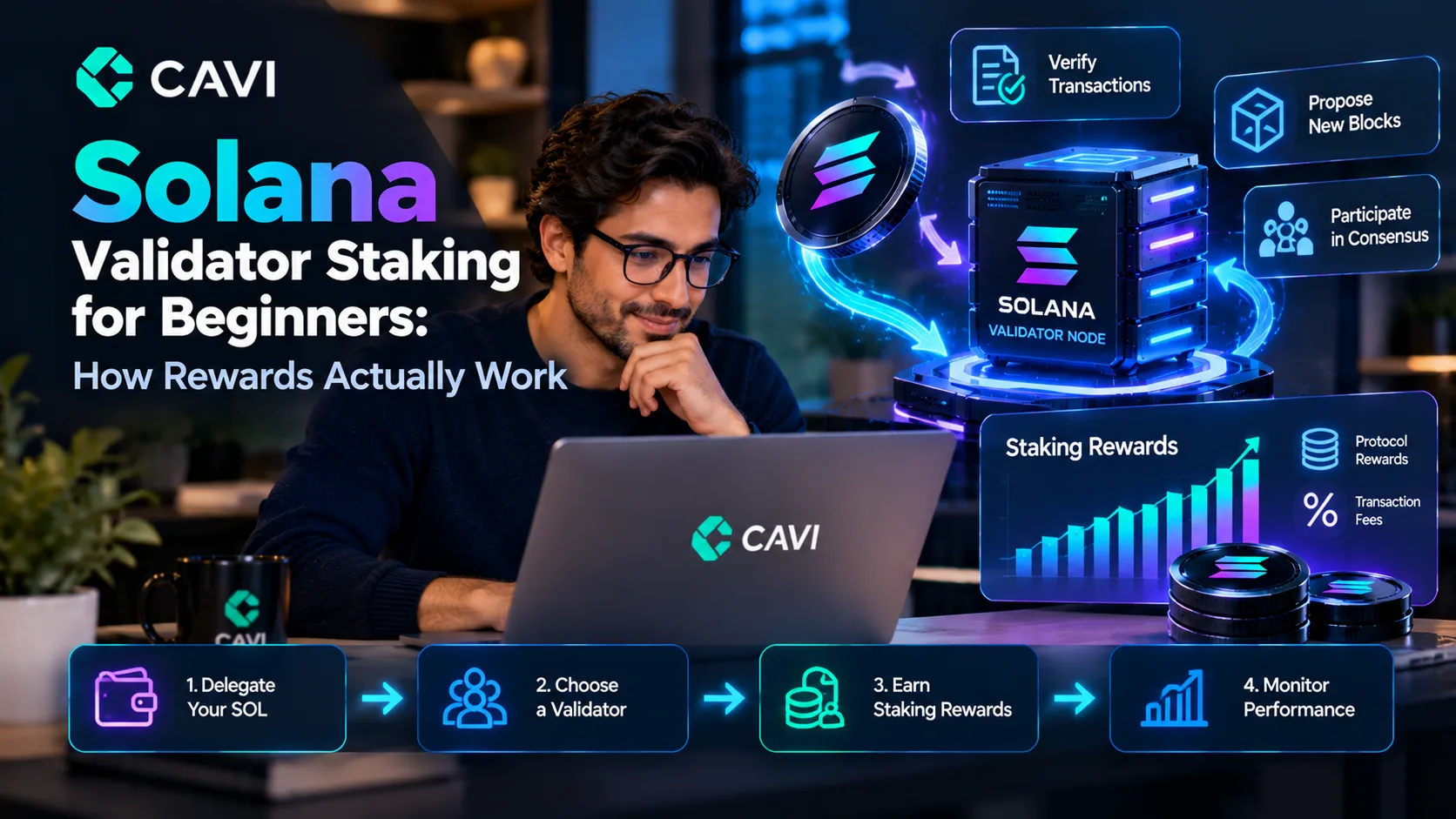
Introduction: Can Your SOL Earn Rewards While You Hold It?
You've bought some Solana (SOL), and you're planning to hold it for a while. Then you hear someone talking about staking and earning rewards on their crypto.
Naturally, you're curious.
Can you earn additional SOL without actively trading? Do you have to hand over your cryptocurrency to someone else? And where do those staking rewards actually come from?
These are sensible questions, especially if you're new to crypto.
The good news is that Solana makes staking relatively accessible. You don't need to run an expensive server or understand blockchain programming to participate. You can delegate your SOL to a validator and potentially earn rewards for helping secure the network.
But there's more to staking than simply clicking a button and watching your balance grow.
Understanding a few basic concepts, such as validators, epochs, commissions, and reward calculations, can help you make better decisions and avoid unrealistic expectations.
In this guide, we'll explain how Solana staking works, what determines your earnings, and what to consider when using a staking service such as CAVI.
1. What Is Solana Staking, and Why Does It Exist?
Before talking about rewards, it helps to understand why staking exists in the first place.
Solana is a blockchain network that processes cryptocurrency transactions and supports decentralized applications.
Unlike a traditional bank, Solana doesn't rely on one central institution to approve transactions or maintain its records.
Instead, it uses a network of independent computers called validators.
These validators help process transactions, create blocks, and keep the network operating correctly.
But how does the network encourage validators to do their jobs properly?
That's where staking comes in.
Solana uses a proof-of-stake consensus system. SOL holders can delegate their tokens to validators, increasing the voting power those validators have within the network.
In return, eligible delegators can receive staking rewards.
A simple way to understand staking
Imagine a group of people maintaining a shared financial record.
They need responsible participants to check new entries and make sure everyone follows the rules.
Instead of appointing one company to manage everything, the network allows independent validators to participate.
People holding SOL can support these validators by delegating their stake.
The validators do the technical work, while delegators help provide the economic weight behind the network.
When the validator participates successfully, rewards may be distributed to the people who have delegated SOL to it.
That's the basic idea behind Solana staking.
Do you give away your SOL when staking?
With native Solana staking, you generally retain control through the authorities assigned to your stake account.
Your SOL is placed into a stake account and delegated to a validator. The validator receives voting power from your delegation, not permission to withdraw your tokens.
This is an important distinction.
However, staking through a custodial platform or a separate smart contract can involve different arrangements.
Always check who controls the withdrawal authority before depositing or delegating assets.
For additional information, see Solana's official staking documentation.
2. Understanding Solana Validators
Think of validators as the computers doing much of the behind-the-scenes work that keeps Solana running.
They process transactions, participate in consensus, and vote on the blockchain's accepted history.
Running one isn't a casual weekend project.
Validators need powerful infrastructure, reliable internet connectivity, technical expertise, and ongoing maintenance.
When you delegate SOL, you're supporting one of these operators.
But not every validator performs equally well.
Some have excellent voting performance and competitive commissions. Others may experience downtime or charge higher fees.
These differences can affect the rewards you receive.
What is a vote account?
Every Solana validator uses a vote account to record its participation in consensus.
When a validator votes on blocks, its voting activity contributes to the calculation of protocol staking rewards.
The network uses the amount of active stake delegated to a validator to determine the weight of its votes.
You don't need to manage a vote account yourself.
As a delegator, you simply need to understand that your chosen validator's voting performance matters.
Why validator performance matters
Suppose two validators have similar amounts of delegated SOL.
Validator A participates consistently and maintains reliable infrastructure.
Validator B frequently goes offline and misses voting opportunities.
Even if both advertise similar commissions, their delegators may receive different rewards because of differences in voting performance.
That's why choosing a validator based only on its advertised reward rate can be misleading.
3. Delegated SOL vs. Activated SOL: What's the Difference?
This is one of the first things that confuses new Solana stakers.
You delegate your SOL, but your wallet doesn't immediately show staking rewards.
Did something go wrong?
Usually, no.
Solana has an activation process.
When you first delegate SOL, your stake account enters an activating state.
The network needs to recognize that stake before it becomes fully eligible for staking rewards.
Once the activation process is complete, your SOL becomes active stake.
Why isn't activation immediate?
Solana organizes network activity into periods called epochs.
Stake activation and deactivation generally take effect at epoch boundaries, subject to network-wide limits.
For a typical small delegation under normal network conditions, activation often completes at the next epoch boundary.
Larger network-wide changes in staking activity can make the process take longer.
Here's what that means in everyday terms.
If you delegate SOL shortly after a new epoch begins, you may need to wait almost the entire epoch before your stake becomes active.
If you delegate shortly before an epoch ends, activation may happen much sooner.
The important thing is that staking rewards don't begin simply because you've submitted a delegation transaction.
Your stake must first become eligible.
4. What Is a Solana Epoch?
An epoch is simply a period used by the Solana network to organize staking and reward calculations.
You can think of it as an accounting cycle.
Solana epochs typically last around two days, although the exact duration can vary.
During an epoch, validators participate in consensus and accumulate voting credits.
At the end of the epoch, the network calculates eligible staking rewards.
Those rewards are then issued at the beginning of the following epoch.
Does that mean Solana pays rewards daily?
Not exactly.
Native Solana staking rewards are generally distributed once per epoch, rather than at a fixed daily time.
A wallet or staking platform may display an estimated daily earnings figure to help users understand their returns.
But an estimated daily figure is different from an actual on-chain reward distribution.
This distinction matters when comparing staking platforms.
If a service advertises daily rewards, check whether it means daily estimates, daily account credits, or actual daily withdrawals.
These are not necessarily the same thing.
5. Where Do Solana Staking Rewards Come From?
Now we get to the question most beginners are interested in.
Where does the extra SOL actually come from?
The primary source of native Solana delegation rewards is the network's inflation mechanism.
Solana creates new SOL according to its protocol's inflation schedule.
A portion of this newly issued SOL is distributed as staking rewards to eligible validators and delegators.
The purpose is to encourage participation in network security.
What about transaction fees?
Solana validators can also receive revenue from transaction fees.
However, there is an important difference between validator revenue and native delegator rewards.
Standard staking rewards paid to delegators primarily come from protocol inflation.
Transaction fee revenue generally goes to block-producing validators under the applicable fee rules. It is not automatically added to every delegator's native staking rewards.
Some validators or specialized services may offer additional reward-sharing arrangements, but those should be explained separately.
Why does the reward rate change?
Your staking return isn't fixed.
It can change because of several factors:
- Solana's inflation schedule.
- The proportion of SOL staked across the network.
- Your validator's voting performance.
- The commission charged by your validator.
- Changes in the network's protocol or reward rules.
Solana's educational material describes approximate staking yields of 5–7% annually, but that is a general reference range rather than a guaranteed or continuously current rate.
For a real staking decision, use live network data and the validator's current performance.
6. How Much SOL Can You Actually Earn?
Let's make the numbers easier to understand.
Suppose you have 100 SOL and decide to stake it.
For this example, we'll assume an illustrative annual reward rate of 6% before commission.
That would represent approximately 6 SOL over one year, assuming the rate stayed unchanged and ignoring compounding.
Now suppose your validator charges a 5% commission on the staking rewards.
The commission would be approximately 0.3 SOL, leaving around 5.7 SOL in rewards for you.
Here's how that example looks:
| Item | Illustrative amount |
|---|---|
| Initial stake | 100 SOL |
| Annual reward rate before commission | 6% |
| Gross annual rewards | 6 SOL |
| Validator commission | 5% of rewards |
| Commission amount | 0.3 SOL |
| Net annual rewards | 5.7 SOL |
These figures are for explanation only. Actual rewards are calculated each epoch, and the rate can change.
What would that mean per epoch?
If we use approximately 182.5 epochs per year, the illustrative average would be:
5.7 SOL ÷ 182.5 ≈ 0.0312 SOL per epoch.
That is not a fixed payout.
Individual epoch rewards may differ, and the actual number of epochs in a year can vary.
What about compounding?
Here's where staking becomes interesting for longer-term holders.
On native Solana staking, issued rewards are automatically added to the active stake account.
That means future rewards can be calculated on a gradually increasing amount of SOL.
You don't generally need to claim each epoch's rewards and manually stake them again.
Over time, compounding can increase the number of SOL you hold.
However, compounding does not guarantee a positive return in dollar terms. The market price of SOL can rise or fall independently of the staking rewards you earn.
7. How Validator Commissions Affect Your Rewards
Not all validators charge the same commission.
Some charge very little. Others retain a larger share of the rewards earned by their delegators.
A validator's commission is normally expressed as a percentage of staking rewards, not the original amount you delegated.
For example, if your stake earns 1 SOL in gross rewards and the validator charges 5%, the validator receives 0.05 SOL.
You receive the remaining 0.95 SOL.
That sounds straightforward, but there is a common mistake worth avoiding.
The lowest commission doesn't always mean the best validator.
A validator charging 0% commission but performing poorly may produce lower net rewards than a reliable validator charging 5%.
It's better to compare commissions alongside voting performance, operating history, and transparency.
Also remember that validators can change their commission rates under the network's rules.
Reviewing those rates periodically is a sensible habit.
8. How to Stake SOL: A Beginner-Friendly Walkthrough
If you're ready to explore staking, the process is usually simpler than the underlying technology makes it sound.
The following steps describe the general native Solana staking process.
The exact screens and available features depend on the wallet or staking service you use.
Step 1: Choose a wallet that supports Solana staking
Start with a compatible wallet.
Popular Solana wallet options include Phantom and Solflare, while hardware-wallet solutions may provide additional key-security options.
Make sure you download wallet software from its official source.
Never share your recovery phrase or private keys with anyone.
Step 2: Add SOL to your wallet
Transfer the amount of SOL you intend to stake.
It's sensible to leave a small amount unstaked to cover network transaction fees.
You don't need to begin with a large amount.
Starting small gives you an opportunity to understand delegation, activation, rewards, and withdrawals before committing more funds.
Step 3: Choose a validator
Open the staking section of your wallet and review the available validators.
Look at their commission rates, voting performance, and operating history.
You may also want to consider how your choice affects network decentralization.
Before selecting any validator presented as associated with CAVI, confirm its official vote account address through CAVI's verified channels.
Step 4: Enter your staking amount
Choose how much SOL you want to delegate.
Your wallet may create a separate stake account for this amount.
Review the transaction details carefully, especially the validator address and the authorities assigned to your stake account.
Step 5: Confirm your delegation
Approve the transaction through your wallet.
Once confirmed, your stake account will generally show an activating status.
This is normal.
You can monitor the account while waiting for activation.
Step 6: Monitor your rewards
After your stake becomes active and completes an eligible reward period, you can begin receiving protocol rewards.
Depending on your wallet, you may see your total staked balance increase rather than a separate reward payment arriving in your main wallet.
You can also use Solana Explorer to inspect stake account information.
Step 7: Review your staking position periodically
You don't need to check your staking balance every hour.
However, it is worth reviewing your validator's performance, commission, and the overall network reward rate from time to time.
If your circumstances change, you can consider adjusting your delegation or beginning the unstaking process.
9. How CAVI Can Fit Into Your Solana Staking Experience
For beginners, the most difficult part of staking often isn't the transaction itself.
It's understanding which validator to choose, what the numbers mean, and whether the service handling the process is trustworthy.
CAVI aims to simplify access to multi-chain staking by bringing staking-related information and services into a more accessible experience.
For someone interested in Solana, the potential benefit of a platform like CAVI is having a clearer way to understand staking activity without personally operating validator infrastructure.
Before using CAVI, however, it's important to confirm the details of its live Solana offering.
These include the supported staking method, validator identity, custody arrangement, applicable commissions, reward-crediting schedule, and withdrawal conditions.
Any claim about Figment infrastructure, validator uptime, or a specific commission rate should be supported by current, verifiable information.
For an overview of the intended platform experience, explore How CAVI Works.
10. Solana Staking vs. Ethereum and BNB Chain
Solana isn't the only blockchain where you can participate in staking.
Ethereum and BNB Chain also support staking, but their processes are not identical.
| Feature | Solana | Ethereum | BNB Chain |
|---|---|---|---|
| Consensus | Proof of Stake | Proof of Stake | Proof of Staked Authority |
| Native delegation | Supported | Not directly through Ethereum's base protocol | Supported |
| Reward timing | Generally each epoch, around 2 days | Consensus rewards accrue by protocol schedule | Network-dependent |
| Validator fees | Validator commission | Depends on staking arrangement | Validator commission or service fees |
| Unstaking | Activation/deactivation process | Exit and withdrawal processes | Delegation unbonding rules |
| Main considerations | Validator voting performance and commission | Slashing, validator operation, staking provider risks | Validator performance, delegation terms, network rules |
For beginners, Solana's native delegation process can be relatively straightforward.
But simplicity doesn't necessarily make one blockchain safer or more profitable than another.
Each network has its own technical design, reward model, and risks.
For a closer comparison, read Ethereum vs. Solana Staking.
11. What Are the Risks of Staking SOL?
Staking can be useful for people who intend to hold SOL, but it isn't risk-free.
Before delegating, consider the following issues.
Validator downtime
A validator that misses votes can earn fewer rewards.
That can reduce the amount distributed to delegators.
Consistent validator performance matters more than flashy reward projections.
Commission increases
A validator may change its commission.
If the commission rises, your share of future rewards can decrease.
This is one reason to review your staking position periodically.
Changes in staking yields
Solana's inflation schedule and overall staking participation influence reward rates.
The rate you see today may not be the rate you receive several months from now.
Unstaking delays
Native SOL staking does not usually provide instant withdrawals from active stake.
You first need to deactivate the stake.
Under normal conditions, deactivation often completes at an epoch boundary, but network-wide warmup and cooldown limits can extend the process.
You should not stake SOL that you may need to access immediately.
Market volatility
Imagine earning an additional 6 SOL on a 100 SOL position over a year.
You now hold more SOL.
But if the price of SOL has fallen significantly during that period, your investment could still be worth less in your local currency.
Staking rewards and investment profits are not the same thing.
Slashing and protocol risks
Solana's official staking documentation states that in-protocol slashing is not currently implemented.
That means ordinary native staking does not currently have the same live slashing mechanism as some other proof-of-stake networks.
However, protocol rules may evolve, and staking still carries operational and market risks.
You should also consider wallet security, phishing attempts, and any additional risks introduced by third-party platforms or smart contracts.
For more information, see Understanding Crypto Staking Risks.
12. How to Choose a Solana Validator You Can Trust
Choosing a validator shouldn't feel like guessing which one will pay the most.
Start with the basics.
Does the validator have a reliable operating history?
Does it participate consistently in network voting?
Is its commission reasonable?
Can you identify the operator and independently verify its performance?
A transparent validator should make it possible for users to evaluate these questions.
You can also consider decentralization.
Delegating everything to the largest operators may be convenient, but supporting competent smaller validators can help distribute voting power more widely across the network.
For larger holdings, splitting stake between multiple validators may reduce dependence on a single operator.
The best choice isn't necessarily the validator with the most attractive headline yield.
It's one whose performance, fees, transparency, and risk profile make sense for your needs.
13. What Do Experienced Solana Stakers Pay Attention To?
Spend time reading Solana staking discussions and you'll notice that experienced participants tend to focus on practical questions.
They want to know whether a validator is performing consistently, whether its commission has changed, and whether rewards are in line with network conditions.
They also pay attention to wallet security and the mechanics of unstaking.
These are useful habits for beginners.
Rather than chasing the highest estimated APY, look at what can actually be verified on-chain.
Communities such as r/solana can be useful places to learn about common staking questions, although individual posts should never replace official documentation or independent checks.
14. Frequently Asked Questions
How much SOL do I need to start staking?
Solana does not impose a large universal minimum for native delegation, but stake accounts must meet applicable rent-exemption requirements, and wallets or services may impose their own minimum amounts.
How often does Solana pay staking rewards?
Native staking rewards are generally calculated and distributed once per epoch, approximately every two days.
Can I lose my SOL when staking?
Native staking does not eliminate risk. Solana currently does not implement in-protocol slashing, but market losses, compromised wallet credentials, operational issues, and third-party platform risks remain possible.
Does staking SOL mean transferring it to a validator?
With native delegation, SOL is held in a stake account controlled by its assigned authorities. Delegation grants voting weight to the validator rather than withdrawal permission. Custodial services may operate differently.
Can I withdraw my SOL whenever I want?
You can initiate deactivation, but the SOL generally becomes withdrawable only after the stake has finished deactivating.
Do I have to claim my staking rewards manually?
Usually not for native staking. Protocol rewards are added to the stake account and automatically become part of its delegated stake.
What happens if my validator goes offline?
The validator may miss voting credits, resulting in reduced staking rewards. The exact impact depends on the duration and nature of the outage.
Can I change validators later?
Yes. You can change your delegation, although the exact process and timing depend on the staking tools and account state involved.
Is Solana staking guaranteed to be profitable?
No. Rewards fluctuate, and the market value of SOL can decline. Earning more tokens does not guarantee a positive financial return.
Is CAVI suitable for Solana staking beginners?
CAVI is intended to simplify access to staking services. Before using it, beginners should confirm the available features, validator details, custody structure, fees, and withdrawal arrangements.
15. Final Thoughts: Understanding Your Rewards Matters More Than Chasing Them
Solana staking can be an accessible way to participate in blockchain security while potentially earning additional SOL.
You don't need to become a validator operator or understand every technical detail of the network to get started.
But knowing how delegation works, when rewards are distributed, and why commissions and validator performance matter can make a real difference.
For beginners, the best approach is usually to start with a manageable amount, choose a validator carefully, and understand the withdrawal process before committing funds.
And remember, staking rewards are only one part of the picture.
Your SOL remains exposed to market movements, and any staking service you use introduces its own considerations.
If you're exploring a platform such as CAVI, focus on transparency and verified information rather than promises of easy income.
The more you understand about how staking actually works, the better equipped you'll be to decide whether it belongs in your crypto strategy.
Related Reading
- What Is Validator Staking?
- How CAVI Works
- Understanding Crypto Staking Risks
- Multi-Chain Wallet Security
- Ethereum vs. Solana Staking
- Do Crypto Nodes Actually Make Money?
Disclaimer: This article is provided for educational purposes only. It does not constitute investment advice or a guarantee of staking rewards. Cryptocurrency prices, protocol rewards, validator performance, and platform conditions can change. Always conduct your own research before staking digital assets.