Liquid Staking Explained: Earn Daily Rewards Without Locking Up Your Crypto on Ethereum, Solana, and BNB Chain
By CAVI Team · 2026-09-11
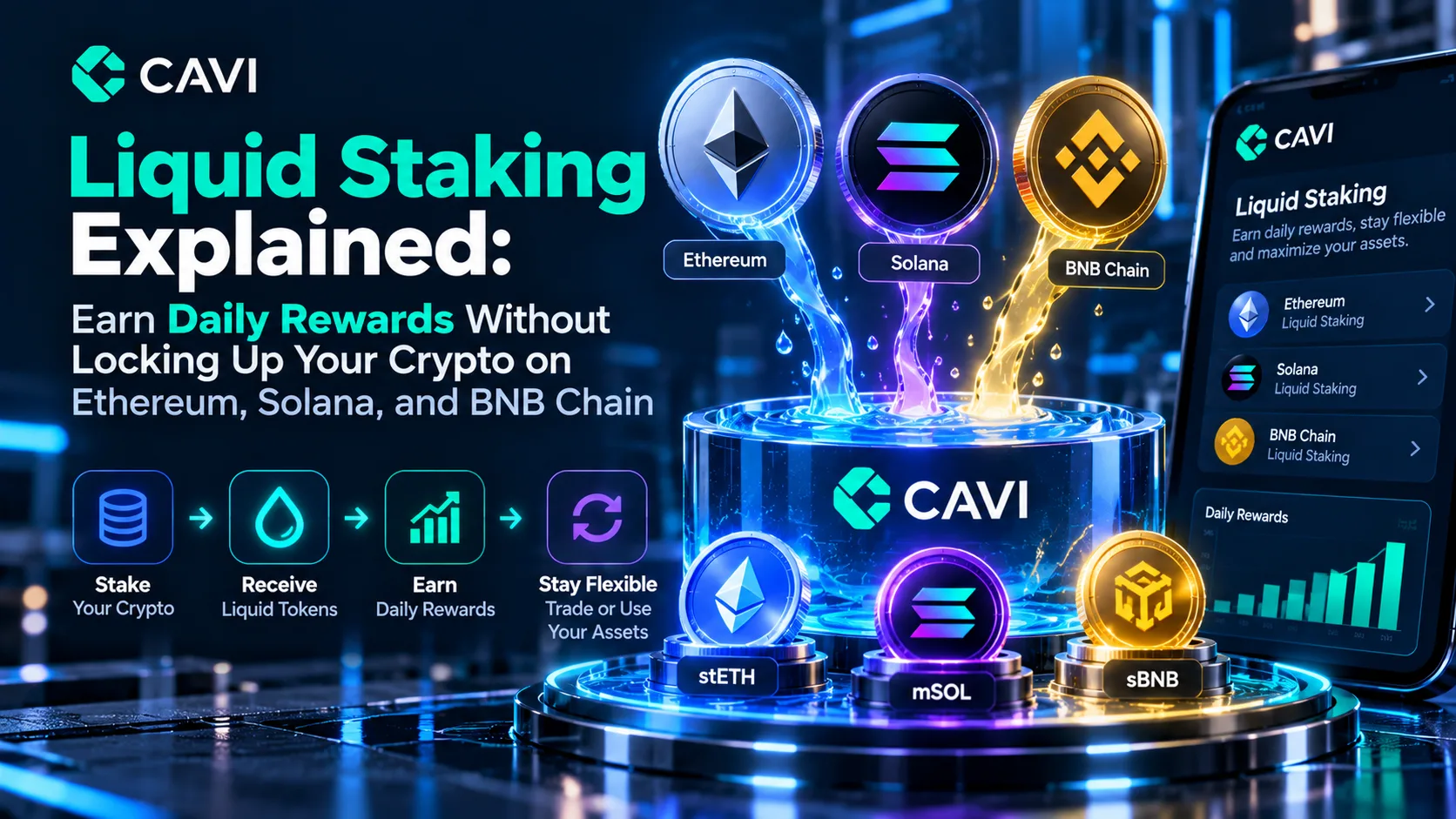
Liquid Staking Explained: Earn Daily Rewards Without Locking Up Your Crypto
Liquid staking lets you earn staking yields and keep your assets liquid for DeFi, trading, or borrowing. In this guide we break down how it works on Ethereum, Solana, and BNB Chain, compare the main liquid‑staking tokens, outline the upside and hidden risks, and show exactly how CAVI lets you capture daily rewards without sacrificing flexibility.
1. What Is Liquid Staking?
Traditional proof‑of‑stake (PoS) staking requires you to lock assets in a validator node for a set unbonding period (e.g., 7‑21 days on Ethereum). While your tokens earn a network‑wide reward (usually 3‑6% APR on Ethereum, 5‑7% APR on Solana, 4‑6% APR on BNB Chain – sources: ethereum.org, solana.com/staking, bnbchain.org), you lose the ability to move or trade them until the unbonding finishes.
Liquid staking solves this dilemma by issuing a staking derivative – a token that represents your staked asset 1:1 (e.g., stETH, mSOL, bETH). The derivative can be transferred, used as collateral, or swapped at any time, while the underlying stake continues to earn rewards in the background. The protocol automatically accrues those rewards to the derivative’s value, so holders see a daily increase in token price rather than a separate reward claim.
“Liquid staking revolutionizes traditional cryptocurrency staking by issuing tradeable derivative tokens that represent your staked assets, allowing you to earn rewards while maintaining full liquidity for DeFi activities.” – LeveX
2. Liquid‑Staking Tokens on the Three Major Chains
| Chain | Main Liquid‑Staking Token(s) | Approx. APR (2024) | Typical Lock‑up (Underlying) | Daily Reward Mechanism |
|---|---|---|---|---|
| Ethereum | stETH (Lido), rETH (Rocket Pool) | 3‑5% APR (source: Lido docs) | 32‑epoch (≈6‑7 days) unbonding | Token price rises ~0.01% / day reflecting accrued yield |
| Solana | mSOL (Marinade), stSOL (Lido Solana) | 5‑7% APR (source: Marinade FAQ) | 2‑3 days withdrawal queue (fast) | Balance updates each epoch (~2 hours) giving near‑daily accrual |
| BNB Chain | bETH (Binance), stkBNB (Beacon Chain) | 4‑6% APR (source: BNB Chain docs) | 21‑day unbonding for native BNB staking, but liquid token can be moved instantly | Token price reflects cumulative rewards, updated per block (~3 seconds) |
Note: APRs are variable and depend on network participation, inflation schedule, and protocol fees. They are not guaranteed.
3. Why Choose Liquid Staking?
- Continuous Liquidity – You can sell, swap, or use the derivative in DeFi instantly.
- Compounding Made Easy – Since the token price reflects accrued rewards, holding the derivative automatically compounds without manual claim.
- Lower Operational Overhead – No need to run your own validator; the protocol handles node operation and reward distribution.
- Access to Additional Yield – Many DeFi platforms accept LSDs as collateral for lending, farming, or leveraged positions, unlocking stacked yields.
- Daily Reward Visibility – Platforms like CAVI credit rewards to your balance every 24 hours, giving a clear, predictable cash‑flow view.
4. Hidden Risks You Must Know
| Risk | Description | Mitigation Strategies |
|---|---|---|
| Smart‑contract Vulnerability | Liquid‑staking protocols are composed of multiple contracts (staking, token, reward distribution). Bugs can lead to loss of funds. | Use audited protocols (Lido, Marinade) and diversify across at least two LSDs. |
| Derivative Price Decoupling | In extreme market stress, the 1:1 peg can temporarily break (e.g., stETH trading at 0.98 ETH). | Monitor price spreads on reputable DEXs; consider rebalancing if discount widens. |
| Protocol Fees | Most LSDs charge a 5‑10% fee on earned rewards, reducing net APR. | Factor fees into ROI calculations; compare fee structures before committing. |
| Liquidity Risk | Some LSDs have lower depth on smaller DEXs, leading to slippage when exiting large positions. | Use high‑volume pools (e.g., Lido on Uniswap) or split exits across multiple venues. |
| Regulatory Uncertainty | Staking derivatives may be classified as securities in certain jurisdictions. | Stay informed on local regulations; keep documentation of staking activities for tax reporting. |
For a deeper dive into staking risk, see our article “Understanding Crypto Staking Risks (And How to Manage Them).”
5. How CAVI Makes Liquid Staking Simple and Daily
CAVI operates validator nodes on Ethereum, Solana, and BNB Chain using Figment‑grade infrastructure. While you could stake directly with a protocol like Lido, CAVI adds two distinct advantages:
- Daily Reward Distribution – Unlike many LSDs that accrue value per epoch (hours or days), CAVI credits daily rewards to your CAVI balance, giving a cash‑flow feel similar to a savings account.
- Unified Multi‑Chain Dashboard – Manage ETH, SOL, and BNB stakes from a single UI, see real‑time APY, and rebalance automatically using our “Auto‑Rebalancer” feature (see “How to Automate Daily Rebalancing of Staked Assets Across Ethereum, Solana, and BNB Chain”).
Because CAVI’s nodes are non‑custodial, you retain full control of the underlying assets; the platform merely delegates them to professional validators. The liquid‑staking token you receive (e.g., cAVISTETH, cAVImSOL) mirrors the same 1:1 peg principle but is settled daily on‑chain.
6. Step‑by‑Step: Start Earning Daily Rewards with CAVI
- Create a Multi‑Chain Wallet – Use a hardware wallet or a software wallet that supports ETH, SOL, and BNB (e.g., MetaMask, Phantom, Trust Wallet). See “Multi‑Chain Wallet Security: Keeping Your Crypto Safe” for best practices.
- Connect to CAVI – Visit the CAVI dashboard, click Connect Wallet, and select the network you wish to stake on.
- Choose Your Liquid‑Staking Option – For each chain you’ll see a card for the native LSD (stETH, mSOL, bETH) and the CAVI‑wrapped version. Review the displayed APR and fee breakdown.
- Deposit the Underlying Token – Transfer ETH, SOL, or BNB to the CAVI contract. The amount you send will be instantly tokenized into the corresponding CAVI LSD.
- Confirm Daily Reward Settings – Enable the Daily Payout toggle. CAVI will calculate the day‑end reward based on the network’s actual yield and credit it to your balance each 24‑hour cycle.
- Optional: Deploy Rewards – You can keep daily rewards in CAVI to compound, or move them to DeFi protocols (e.g., lend on Aave, provide liquidity on Uniswap). Because the rewards are already in a liquid token, there’s no extra unbonding delay.
- Monitor & Rebalance – Use the built‑in analytics panel or enable the auto‑rebalancer to keep your portfolio aligned with your target APY mix.
7. Community Pulse
- Reddit discussion – The r/ethstaker community frequently debates the trade‑off between native staking and LSDs. A recent thread (2024‑07) highlights users’ preference for daily‑reward platforms like CAVI for cash‑flow needs: https://reddit.com/r/ethstaker
- Twitter chatter – Search the hashtag #liquidstaking for real‑time sentiment and strategy sharing: https://x.com/search?q=%23liquidstaking
8. Frequently Asked Questions
| Question | Answer |
|---|---|
| Do I still own the underlying asset? | Yes. The LSD is a representative claim; you can redeem it for the original token (subject to the underlying protocol’s unbonding schedule). |
| Are rewards truly “daily”? | CAVI aggregates the network’s per‑epoch rewards and distributes them once per 24 hours. Other protocols may update price continuously but credit to your wallet less frequently. |
| Can I unstake instantly? | You can swap or sell the CAVI LSD at any time. Converting back to the native token may incur the underlying protocol’s unbonding period (e.g., 7 days on Ethereum). |
| What fees does CAVI charge? | CAVI applies a flat 5% fee on the gross reward, comparable to Lido’s 10% on stETH but lower than many niche LSDs. |
9. Final Thoughts
Liquid staking bridges the gap between yield generation and capital efficiency. By tokenizing your stake, you keep assets tradable, unlock DeFi composability, and receive daily reward payouts that feel like a traditional income stream. However, the convenience comes with smart‑contract risk, fee drag, and occasional price decoupling.
CAVI’s multi‑chain validator service gives you a single point of access to Ethereum, Solana, and BNB Chain liquid staking, with daily reward settlements and automated rebalancing tools. Whether you’re a long‑term holder looking for steady income or a DeFi power user wanting to stack yields, CAVI offers a transparent, secure, and user‑friendly path.
Ready to start? Visit the CAVI dashboard, connect your wallet, and begin earning daily rewards without ever locking up your crypto.
Further Reading
- How Network Upgrades Impact Staking Rewards: Ethereum Shanghai, Solana 2024 Upgrade, and BNB Chain Beacon Chain Explained
- How Much Can You Earn Staking $1,000 in Crypto? Daily Rewards Explained
Disclaimer: Staking rewards are variable and not guaranteed. Always conduct your own research and consider the risks before allocating capital.