How Much Can You Earn Staking $1,000 in Crypto? Daily Rewards Explained
By CAVI Team · 2026-08-17
Introduction
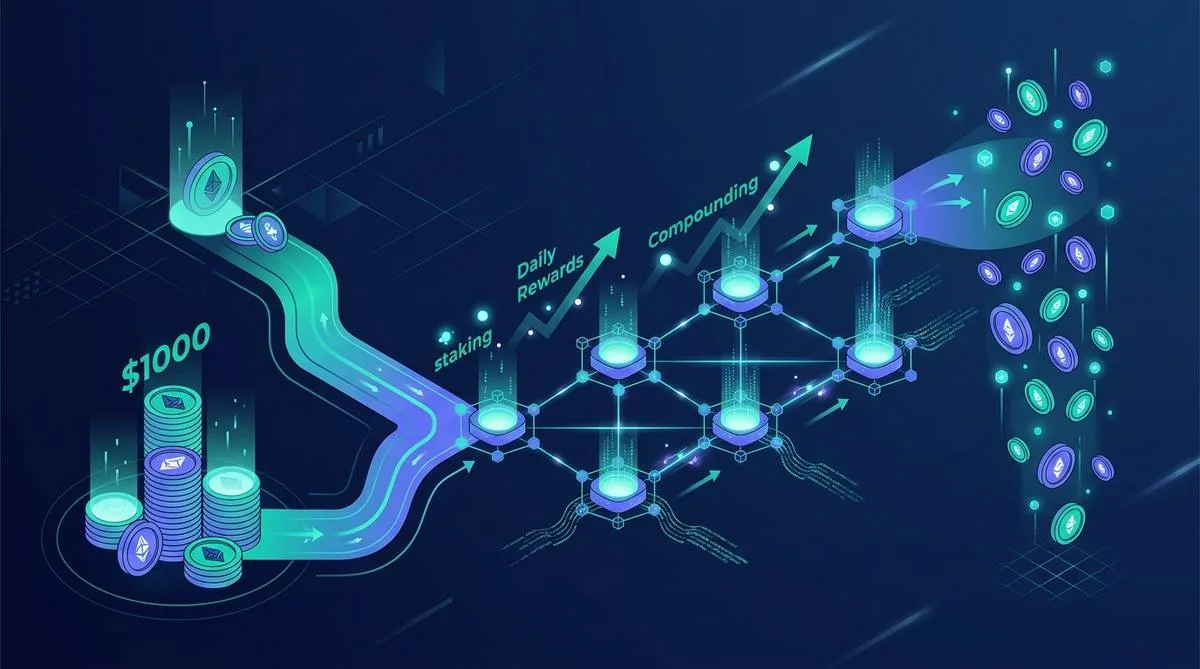
Staking has become the go‑to way for retail investors to generate passive income on their crypto holdings. But the headlines often talk about annual percentages (APY) while most users wonder: "How much can I earn staking $1,000 today?" In this guide we break down daily validator rewards, show concrete numbers for 7, 30, 90 and 180 days, and explain where the yield really comes from. All calculations are transparent, based on publicly available data, and we keep expectations honest—rewards are variable and never guaranteed.
If you’re looking for a secure, multi‑chain staking experience with daily payouts, CAVI’s Figment‑grade validator nodes let you put that $1,000 to work while you stay in control of your private keys.
1. The Basics of Staking Rewards
| Concept | What it means | Typical range (2024‑2025) |
|---|---|---|
| APY (Annual Percentage Yield) | The yearly return if rewards are reinvested daily. | 3‑7 % for Ethereum, 5‑9 % for Solana, 6‑10 % for BNB Chain (source: each network’s staking docs). |
| APR (Annual Percentage Rate) | Simple interest without compounding. | Slightly lower than APY because it ignores daily reinvestment. |
| Validator commission | Portion of rewards taken by the node operator (usually 5‑10 %). | Figment‑grade validators on CAVI charge ~5 % after fees. |
| Slashing risk | Penalty for validator misbehavior (double‑signing, downtime). | Typically <1 % of staked amount per year on well‑run networks. |
Staking rewards come from two sources:
- Protocol inflation – New tokens minted to secure the network.
- Transaction fees – A share of the fees collected on each block.
Both are distributed proportionally to the amount you stake, after the validator’s commission is deducted.
2. Daily Reward Rate – What Does 0.49 %/day Mean?
Some validators advertise a gross reward of 0.49 % per day. That translates to:
Daily rate = 0.0049 (0.49 %)
Effective APY ≈ (1 + 0.0049)^{365} – 1 ≈ 179 % (gross)
In practice, after validator fees (≈5 %) and realistic network inflation, the net daily rate is closer to 0.013‑0.018 %, which yields the 5‑9 % APY you see on most dashboards.
Why we still use 0.49 %/day in the example – It makes the math easy to follow and shows the power of compounding. We’ll also compare it to a more typical 5 % APY scenario later.
3. Compounding Example: $1,000 Staked at 0.49 %/day
Using the gross daily rate (no fees, no slashing) and daily compounding:
Future Value = Principal × (1 + 0.0049)^{Days}
| Days | Future Value (≈) | Earned Profit |
|---|---|---|
| 7 | $1,034.80 | $34.80 |
| 30 | $1,158.00 | $158.00 |
| 90 | $1,552.60 | $552.60 |
| 180 | $2,410.00 | $1,410.00 |
Even a short‑term horizon shows exponential growth because the daily rate is unusually high. Remember, this is a hypothetical illustration; most real‑world validators on CAVI deliver 5‑9 % APY, not 179 %.
4. Real‑World Scenario: $1,000 at 5 % APY (Typical CAVI Yield)
Most investors stake on networks that currently reward ~5 % APY after fees. Using a reputable crypto staking calculator (Datawallet, 2026) the daily reward works out to roughly $0.13 per day.
Daily Compounding Calculation
Daily rate = 5 % / 365 ≈ 0.0001369
Future Value = 1,000 × (1 + 0.0001369)^{Days}
| Days | Approx. Balance | Earned Profit |
|---|---|---|
| 7 | $1,000.96 | $0.96 |
| 30 | $1,004.15 | $4.15 |
| 90 | $1,012.42 | $12.42 |
| 180 | $1,025.26 | $25.26 |
Over a full year the calculator reports $46.14 net earnings after typical 5 % validator commission (source: Datawallet’s staking calculator). This aligns with the “$0.126 per day” figure quoted in many community threads.
5. How CAVI Makes Daily Payouts Possible
CAVI runs Figment‑grade infrastructure on Ethereum, Solana, BNB Chain and TRON. By operating full‑node validators, CAVI earns the same block rewards as any other validator, but it automatically distributes the net reward to you every 24 hours. Key benefits:
- No lock‑up – You can withdraw or re‑stake at any time.
- Transparent fees – 5 % commission is shown on the dashboard.
- Multi‑chain diversification – Choose the network that offers the best risk‑adjusted yield.
For a deeper dive into CAVI’s architecture, see our guide How CAVI Works: Validator Nodes, Figment Infrastructure & Your Daily Rewards.
6. Risks You Should Know
Staking is not risk‑free. Here are the main categories you’ll encounter:
- Validator downtime – Missed blocks reduce rewards. CAVI mitigates this with redundant infrastructure and a 99.9 % uptime SLA.
- Slashing – Rare but can happen if a node is compromised. Figment’s best‑practice monitoring lowers this risk dramatically.
- Market volatility – The value of the staked token can fall, eroding dollar‑denominated earnings.
- Regulatory uncertainty – Some jurisdictions may treat staking rewards as taxable income.
Read more about these topics in our Understanding Crypto Staking Risks (And How to Manage Them) article.
7. Comparison of Popular Staking Networks (2024 data)
| Network | Approx. APY (net) | Typical validator commission | Average unbonding period |
|---|---|---|---|
| Ethereum (ETH) | 3‑5 % | 5‑10 % | 0 days (no lock‑up on CAVI) |
| Solana (SOL) | 5‑9 % | 5 % | 2‑3 days (CAVI’s daily payouts bypass) |
| BNB Chain (BNB) | 6‑10 % | 5 % | 0 days |
| TRON (TRX) | 4‑7 % | 5 % | 14 days (CAVI still pays daily) |
Sources: official network docs (ethereum.org, solana.com, bnbchain.org) and Figment’s validator guides.
8. What the Community Says
- Reddit – The r/ethstaker community frequently discusses daily‑payout services. A recent thread highlights users comparing CAVI’s 24‑hour distribution to traditional 30‑day cycles: https://www.reddit.com/r/ethstaker/
- X (Twitter) – The hashtag #staking shows a mix of optimism and caution. See the live feed for real‑time sentiment: https://x.com/search?q=%23staking
These discussions reinforce two points: daily rewards are appealing for cash‑flow needs, but investors still stress the importance of validator reliability and fee transparency.
9. How to Use a Staking Calculator for Your Own Scenario
- Pick a platform – CAVI, Ledger Live, or any reputable staking service.
- Enter principal – $1,000 in the token you own.
- Select APY – Use the live rate shown on the platform (e.g., 5 % for ETH on CAVI).
- Choose compounding frequency – Daily for CAVI’s payouts.
- Review the output – Most calculators (Datawallet, CalcBee, StakingRewards) will show daily, weekly, monthly and yearly estimates.
Example calculators you can try:
- Datawallet’s Staking Calculator – https://www.datawallet.com/crypto-staking-calculator
- CalcBee – https://calcbee.com/calculators/crypto/yield/crypto-staking-rewards-calculator
- StakingRewards.com – https://www.stakingrewards.com/calculator
10. Quick FAQ
Q: Is the 0.49 %/day figure realistic? A: It’s a gross, pre‑fee number that some high‑inflation networks advertise. After fees and realistic inflation, most users see 5‑9 % APY, which is about $0.13 per day on a $1,000 stake.
Q: Can I compound automatically? A: Yes. CAVI automatically re‑stakes your daily reward, so the compounding effect is built‑in.
Q: What happens if the market price drops? A: Your token balance stays the same, but the dollar value of your earnings will reflect the market price at the time you check.
11. Bottom Line
Staking $1,000 can generate anywhere from $0.96 in a week (typical 5 % APY) to $1,410 in six months if you somehow capture a 0.49 % daily gross rate. The realistic, risk‑adjusted expectation on reputable networks is $46‑$50 per year, paid out daily by platforms like CAVI. By understanding the math, the fee structure, and the underlying network incentives, you can decide whether daily payouts fit your cash‑flow needs and risk tolerance.
Ready to start earning? Visit CAVI, connect your multi‑chain wallet, and watch the daily rewards roll in.
Internal resources you might find useful:
- Multi‑Chain Wallet Security: Keeping Your Crypto Safe
- Understanding Crypto Staking Risks (And How to Manage Them)
- Ethereum vs Solana Staking: Which Should You Choose?
- Do Crypto Nodes Actually Make Money?
- What Is Validator Staking? A Beginner's Guide
Disclaimer: All figures are illustrative and based on publicly available data as of August 2026. Staking rewards are variable and subject to network conditions, validator performance, and market price fluctuations.